
From the archive. This article first appeared on China Law Insider in February 2017 and describes the registration regime introduced by MOFCOM in October 2016. Procedures have since evolved under the Foreign Investment Law (2020); contact the firm for current guidance.
In 2016, China’s government passed a new foreign investment law (the Foreign Invested Enterprises Law) designed to make the PRC a more attractive environment for foreign investors. In connection with this new law, the Chinese government, through the Ministry of Commerce (MOFCOM), also issued new regulations regarding the formation and registration of wholly foreign-owned enterprises (WFOEs) in October 2016. A WFOE is a common investment vehicle which foreign parties typically use to incorporate a foreign-owned limited liability company in the PRC. These changes significantly simplified and streamlined the process for establishing a WFOE.
The new process consists of five basic requirements. It can seem simple, but it contains traps for the unwary that could prevent a foreign investor from commencing operations in the PRC, or significantly delay the investor’s ability to do so, potentially resulting in lost revenue or business opportunities.
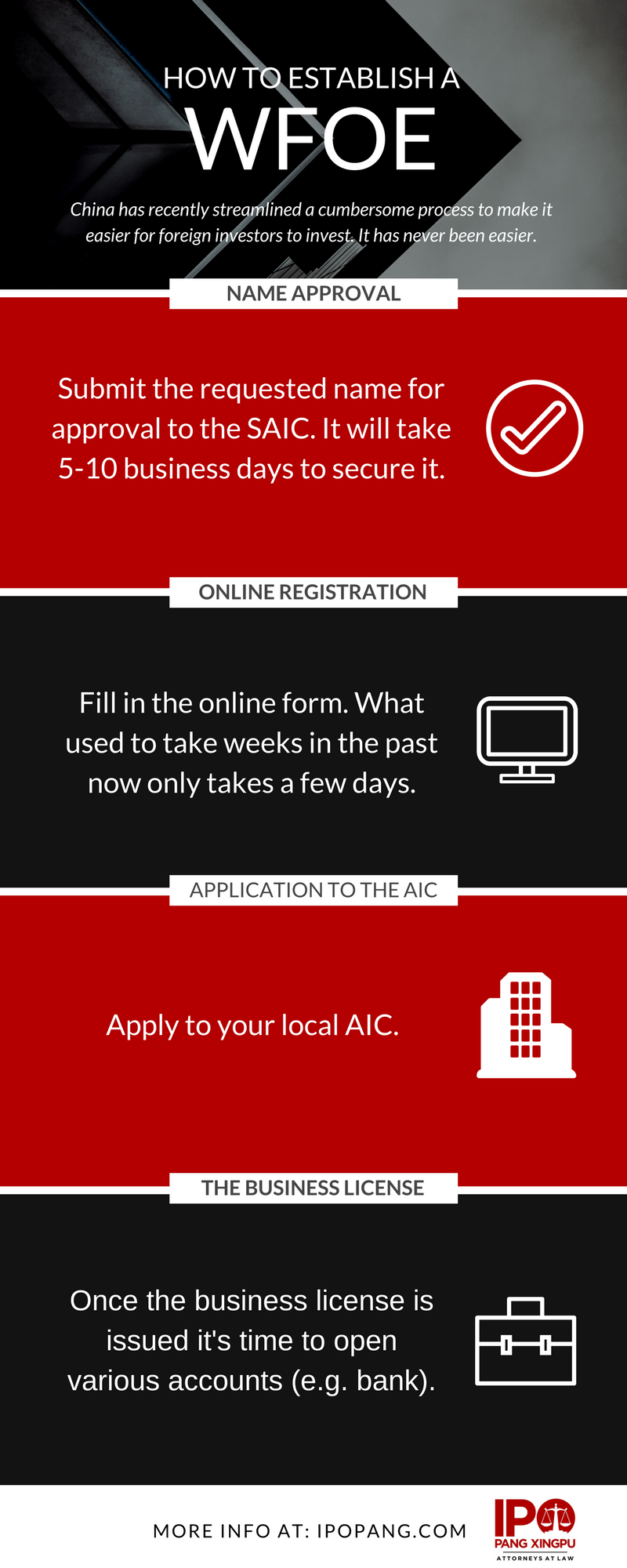
1. WFOE name approval
The first step is to receive approval of the WFOE’s name. The foreign investor must submit paperwork to the State Administration of Industry and Commerce (SAIC) to ensure the requested corporate name is available and obtain approval to use it. This process typically takes 5 to 10 business days and results in the name being reserved solely for that investor.
2. Online registration with the Ministry of Commerce
One of the major changes to the regime is that MOFCOM previously had to approve the establishment of each WFOE, whereas investors now carry the much lighter burden of registering with MOFCOM. Registration is completed through an online form and can be achieved entirely on the internet, perhaps the biggest single change from the previous regime. The earlier approval process typically consumed 15 business days on its own; the registration requirement shortens the overall timeline considerably.
3. Application to the local Administration of Industry and Commerce
Once the first two steps are complete, the investor applies to the local AIC to actually form the WFOE.
4. Issuance of the business license
This step is accomplished by submitting paperwork corresponding to the industry in which the WFOE plans to operate, its owners, and other required documentation regarding the proposed business’s operations. The AIC then issues the business license.
5. Start the operational processes
Once the other four steps have been completed, the WFOE formalizes its operations: opening bank accounts, opening tax and other government accounts, setting up daily bookkeeping and reporting to the local government, executing written employment agreements with employees, and opening employee tax and social-benefit accounts for each Chinese employee.
A deliberate move to encourage foreign investment
The Chinese economy is dominated by large state-owned enterprises in many industries. In an effort to encourage further foreign investment, the PRC government made major changes to streamline the process for establishing a WFOE, reducing the time required by two to three months compared with the pre-October 2016 process. Nevertheless, this remains a process that can be difficult to follow for those new to the Chinese market, and experienced local counsel can prevent costly missteps at each stage.