
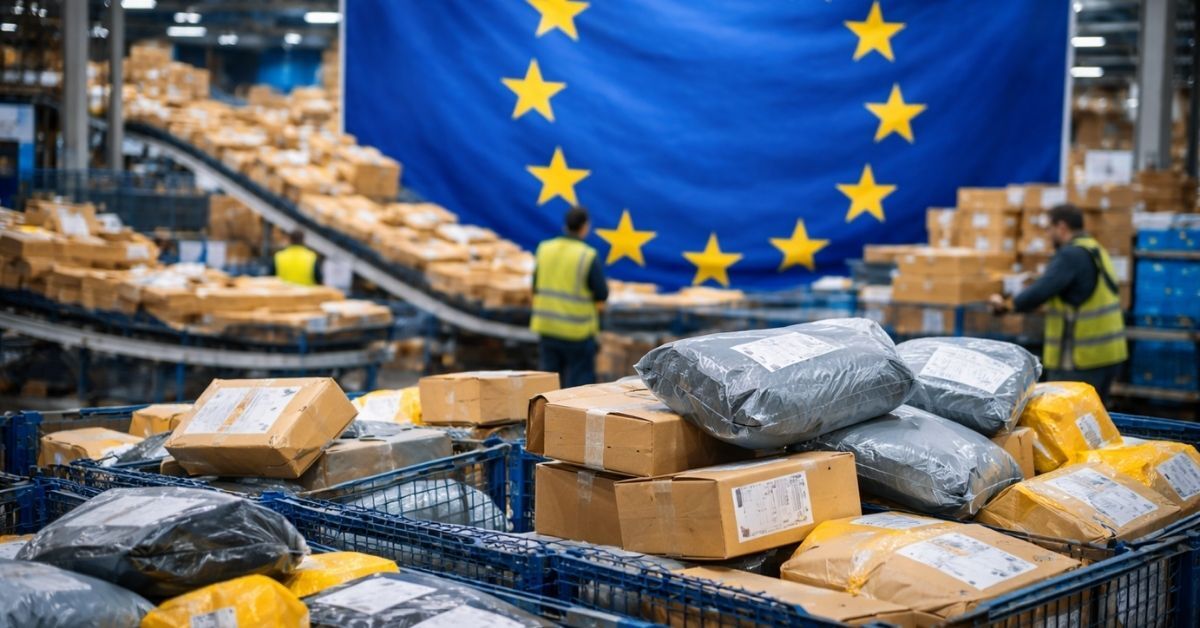
The EU has added a €2 handling fee, in force from 1 November 2026, to the €3 customs duty on low-value parcels that came into effect in July. This ends a decade of duty-free parcels, and Chinese platforms and sellers are the most affected. Initial data shows a large impact and raises strategic considerations for Chinese businesses.
I. What Has Changed
Previously, parcels with a value of up to €150 were free of customs duty. From 1 July 2026, a €3 duty has been introduced to cover all item types within parcels. This is a tariff-based duty, meaning that five identical T-shirts will incur a duty of €3, whilst a parcel containing three T-shirts and a watch will incur a duty of €6. The duty will be declared by either the seller, importer or customs agent and is temporary, with the duty to be in place until 1 July 2028, when the EU will introduce a permanent system of standard tariffs.¹
The handling fee of €2 came into effect on 1 November. This is a permanent charge to cover all item types, irrespective of the value. The fee will be reviewed every two years by the EU to ensure it remains aligned to customs costs. Ten T-shirts would incur a fee of €2, whilst two hats and ten T-shirts would incur a fee of €4. This is a top-up to the €3 duty.² From 1 November, product identification has also become mandatory to allow authorities to track and identify non-compliant goods.³
At a glance:
- Customs duty of €3. In force from 1 July 2026. Charged on each item type, for goods up to €150. Temporary, until 1 July 2028.
- Handling fee of €2. In force from 1 November 2026. Charged on each item type, whatever the value. Permanent; reviewed every two years.
- Product identifiers. In force from 1 November 2026. Required for goods in low-value parcels, for traceability. Mandatory.
II. Why Brussels Acted
The European Commission has stated that they are doing this to ensure fairness, safety and prevent fraud. Prior to this, sellers outside the EU would not incur any duty or compliance costs for sending low-value parcels.¹ The volume of low-value parcels sent to the EU has doubled to 4.6 billion in 2024, with over 90 per cent of these parcels originating from China. In 2025, almost 5.9 billion items were sent to the EU.³ Targeted checks in 2025 showed that over 60 per cent of products checked were non-compliant with EU standards relating to items such as toys, cosmetics and electronics. Undervaluation and incorrect declarations were also cited by customs authorities.
Initial data shows that the measures are having the intended impact.
Officials state that imports have dropped by around 64 per cent since the duty came into place in July.
However, it is early days.²
III. Who Is Affected
The biggest direct impact will be on cross-border platforms. Temu, Shein and AliExpress all have a business model built around sending low-value, cheap items directly from China. The duty and fee mean a fixed cost will apply to all item types. This will impact the cheapest items most as they will have a large proportion of their price going towards the €5 charge.
The platforms are adapting. Temu’s co-CEO Lei Chen stated in August that they are investing in a new fulfilment strategy in the EU and employing local merchants. However, he also acknowledged that most of their merchants are not based in the EU or the US.⁵ Shein have been investing in warehouse space in Wrocław, Poland and sending more in bulk to the EU. AliExpress have said they will include a note on their listings that prices include duty and VAT.³ Amazon states that most of their orders in the EU are fulfilled locally. Whilst this does not eliminate duty costs, importing in bulk will incur standard duty and VAT. This will however be spread across many units and reduce delivery times.
Smaller Chinese sellers will find it more of a challenge. Many of these sellers use platforms to sell to Europe and do not have enough volume to invest in EU warehousing. They will need to consider whether to absorb the costs, increase prices, move to higher-value items or use a local distributor. The logistics sector will also be impacted, with couriers, postal services and air freight companies who have seen rapid growth in small parcel shipments seeing a shift to bulk. On the EU side, those retailers who have been competing against free imports will see some relief. Consumers should expect higher prices for the cheapest items.
Whilst the EU insists that consumers should not pay the handling fee, retailers and sellers may choose to include the €2 charge. However, the consumer group BEUC has warned that this would be illegal to charge at the final point of sale as EU law states that the total price must be shown upfront.²
IV. What Comes Next
This is just a stepping stone to a bigger change. The EU is looking to create a new customs authority and the provisional agreement states that online platforms will be responsible for paying duty and ensuring products are safe. The authority is expected to start processing e-commerce shipments in 2028.⁴
Overall, Chinese platforms will be expected to act more like regulated importers rather than distant exporters.
V. The Wider EU–China Relationship
This should be viewed in the context of a wider shift in EU–China trade. The EU has a significant trade deficit with China and Brussels have become increasingly concerned about the increase in machinery, textiles, metals and chemicals coming from China. This is sometimes referred to as the second China shock. Last year China restricted rare earth exports, causing concern amongst European manufacturers.⁷ In June, both parties agreed to show progress on trade issues by October. The EU Trade Commissioner was scheduled to meet China’s commerce minister in Beijing on 8–9 October, followed by a meeting of EU leaders on 15–16 October.⁶ MERICS expects tensions to continue, with pressure in Europe to introduce tighter trade tools.⁸
The new charges apply to all non-EU parcels, whatever their country of origin.¹ Other major markets are moving the same way. The UK will remove its customs relief for goods valued under £135 by October 2028,⁹ and the United States suspended duty-free de minimis treatment for goods from all countries from 29 August 2025.¹⁰
VI. Legal Recommendations
China-law note: This section provides information on EU law only and is not a recommendation that Chinese entities cooperate in implementing unilateral EU trade measures. Before taking any steps, Chinese entities should assess their obligations under the Anti-Foreign Sanctions Law and the Blocking Rules.
For Chinese Exporters and Platforms Selling to the EU
- Ensure your products are correctly classified. As this applies to all item types, you will need to know what tariff your products fall under to understand the costs. Incorrect classifications may lead to penalties.
- Ensure correct values and descriptions are declared. Undervaluation is a key priority for enforcement.
- Ensure you are prepared for product safety requirements. Product identification has been mandatory since 1 November. Ensure your products meet EU standards.
- Consider your logistics strategy. Sending directly to the consumer may still be viable for higher-value items. For low-value items, you may need to stock in the EU, use a local partner or change your mix. Ensure you know who your importer of record is for each flow. The party declaring the goods will be responsible for the duty and compliance risk.
- Show the full price upfront. If you pass the €2 handling fee on to consumers, build it into the displayed price rather than adding it at checkout. BEUC has warned that adding it at the final point of sale would be unlawful, as EU law requires the total price to be shown upfront.²
VII. How We Can Help
IPO Pang Shenjun provides advice on cross-border trade, customs and compliance for Chinese and international companies from our Shanghai and Washington offices. We can help you understand how your products are classified and declared, review your import and fulfilment strategy for the EU and work with local counsel in the EU.
This article is for general information only and does not constitute legal advice. Specific advice should be sought on individual circumstances.
VIII. References
- European Commission, Ensuring fairness and safety: €3 customs duty on low-value parcels (29 June 2026).
- AFP, New levy on non-EU parcels kicks in November 1 (26 October 2026).
- Retail Gazette, Shein and Temu hit by new EU customs duty on cheap parcels (July 2026).
- Jing Daily, EU targets Shein, Temu and AliExpress with customs reform (27 March 2026).
- Ship24, Temu and Shein expand local fulfilment in Europe: what changes in tracking.
- Bloomberg Tax, EU and China agree on October deadline to reset trade ties.
- AFP via Sharjah24, EU trade chief to visit Beijing on Oct 8–9 to tackle tensions (17 September 2026).
- MERICS, China Essentials (8 October 2026).
- Baker McKenzie, UK Low Value Import Relief to be Removed by October 2028 (24 July 2026), reporting HMRC’s policy paper of 13 July 2026.
- US Customs and Border Protection, CSMS # 66065494 – Guidance: Suspension of Duty-Free De Minimis Treatment for All Countries (28 August 2025).
Copyright 2026 IPO Pang Shenjun PLLC. All Rights Reserved.