
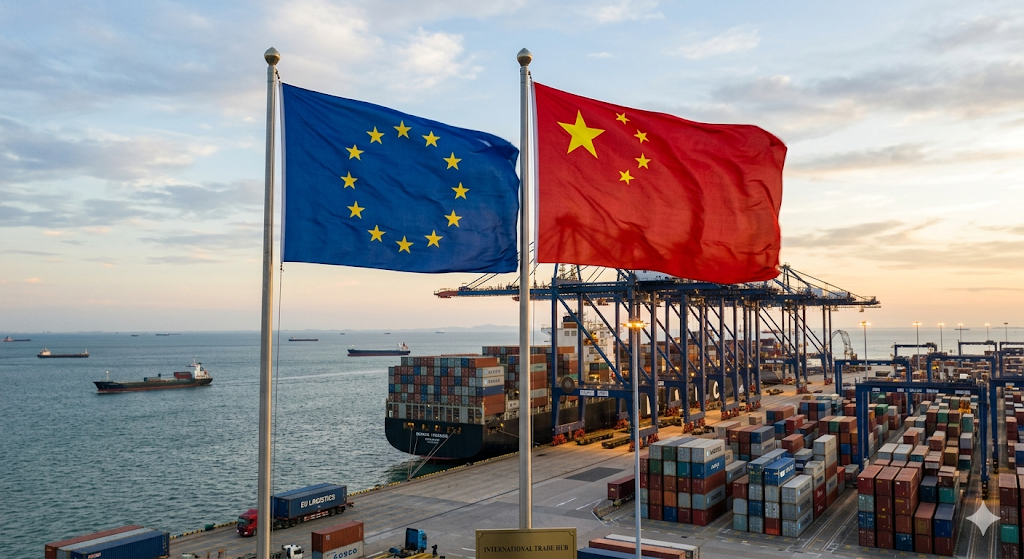
On 29 May 2026, the European Commission did something it had long skirted around: it said plainly, in writing, that its trade and investment relationship with China no longer works. Following a strategic orientation debate among commissioners, the Commission published a statement that read in part: "China is a critical partner, and engagement and dialogue will continue. At the same time the current state of the trade and investment relationship is not sustainable. As economic and security interests become ever more intertwined, both dimensions will require a more robust and coherent response."
The word "decoupling" does not appear anywhere in that statement. Brussels is not proposing to sever ties with Beijing. The Commission's position is de-risking, which in practice means maintaining trade while reducing structural exposure in strategic sectors including raw materials, batteries, semiconductors, solar panels, and clean energy technology. The distinction matters legally and commercially. But the language has hardened, the policy instruments being assembled are more substantial than previous rounds, and the private acknowledgement inside the Commission is that China will retaliate.
The numbers behind the frustration
The bilateral trade arithmetic has moved in one direction for years. According to Eurostat data, the EU goods trade deficit with China reached €98 billion in Q1 2026 alone, the largest quarterly deficit since Q3 2022, driven by a 3.4% rise in imports from China and a simultaneous 4.8% fall in EU exports to China over the same period. On a full-year basis, the 2025 deficit was a record €359.9 billion.
The composition of that deficit is as concerning to Brussels as the headline number. Nearly all Chinese goods entering EU markets are manufactured products, and European companies across dozens of industries have become structurally dependent on Chinese inputs for components, intermediate goods, and finished products. That dependency tends to deepen rather than self-correct over time, particularly as Chinese industrial upgrading accelerates in sectors where European companies once held competitive advantages.
What Brussels is planning
The May 29 debate was timed ahead of the European Council summit on 18-19 June and the G7. Concrete legislative proposals are not expected until Q3 2026. The direction, however, is clear from what has already been floated publicly and from the member state positioning now on the record.
EU industry chief Stéphane Séjourné characterized the competitive threat from China as "existential," with the working plan focused on expanding import quotas, tariffs, and sector wide safeguard measures across chemicals, metals, and clean technology. A five member coalition of France, Italy, Spain, the Netherlands, and Lithuania submitted a joint document in late May calling on the Commission to broaden anti-dumping and anti-subsidy investigations beyond single products to entire industrial sectors, raise local content thresholds for goods transiting third countries that serve as circumvention points, and develop an entirely new instrument to cap dependence on any single foreign supplier.
The Commission has already been scaling up enforcement activity. In 2024 it lodged seven anti-dumping cases against China. In 2025 that rose to 17. As of mid-2026 there are more than 50 ongoing cases, with duties already imposed on electric vehicles, solar supply chain components, steel cylinders, glass fibers, and several other product categories.
China's response
Beijing has been direct about its position. Ahead of the 29 May meeting it signaled that any new restrictions on Chinese exports would be met with countermeasures. That is not a new threat. Since the EU imposed provisional tariffs on Chinese electric vehicles in 2024, Beijing has deployed retaliatory measures against European agricultural products, most notably pork, and has initiated anti-dumping probes into European brandy and dairy imports.
The Commission's internal discussions privately accepted that retaliation is likely regardless of how carefully Brussels calibrates its next steps. That acceptance is itself significant. For years the dominant concern inside the EU was that any assertive trade action would trigger Chinese countermeasures painful enough to cause member state defections from a unified position. The May 2026 debate suggests Brussels has decided the cost of continued inaction is higher.
The practical cost of de-risking
Supply chain reconfiguration is expensive and slow. A manufacturer currently sourcing the majority of its critical sub-assemblies from China faces significant cost increases when splitting orders across Eastern Europe or Southeast Asia, compounded by the capital expenditure, permitting, labor qualification, and supplier development timelines involved in any meaningful reshoring. These costs are structural, not transitional, and will be distributed across European businesses and their customers throughout the adjustment period.
The enforcement architecture also has genuine limitations. Anti-dumping investigations are product-specific, can take up to 18 months to complete, and require a qualified majority of member states to approve each measure. That is a slow instrument against a trade problem that moves faster than the legal procedures designed to address it. The proposed shift toward sector-wide safeguards would address some of that latency, but the design and legal defensibility of those tools is still being worked out.
What this means for clients
For European companies with China supply chains: The Commission's policy direction is now explicit and has broad member state backing. Businesses that have been deferring supply chain diversification decisions should treat the Q3 2026 proposals as a planning deadline rather than a distant contingency. Mandatory diversification requirements, sector-wide safeguards, and tighter local content rules are all under active consideration.
For Chinese companies operating in or exporting to EU markets: The expansion of investigations from product-specific to sector-wide coverage represents a material shift in exposure. Companies in chemicals, metals, clean energy, and advanced manufacturing should be reviewing market access risk now and developing legal strategy ahead of Q3 announcements rather than waiting for measures to be formally adopted.
For cross-border investors: The Commission's explicit framing of this as an economic security issue rather than a trade policy adjustment has direct implications for deal structuring, regulatory approvals, and foreign investment screening. The proposed outbound investment screening mechanism would introduce new approval requirements for capital flows that currently face no formal review in the EU.
For EU exporters to China: Beijing's retaliatory toolkit is active and expanding. Agricultural producers, automotive companies, and luxury goods manufacturers should factor the link between EU policy escalation and Chinese trade countermeasures into their operational risk assessments. That link is now a predictable feature of the bilateral relationship, not an exceptional event.
References
Bloomberg. (2026, May 29). EU warns trade relationship with China is 'not sustainable.' bloomberg.com
Bloomberg. (2026, June 3). Left with few choices, EU braces for a trade fight with China. bloomberg.com
European Commission. (2026, May 29). Statement following College of Commissioners orientation debate on EU-China relations.
EuropeSays. (2026, May 30). European Commission vows tougher action on trade with China as deficit hits €360 billion. europesays.com
Eurostat. (2026). EU trade with China: Latest developments. European Commission. ec.europa.eu