
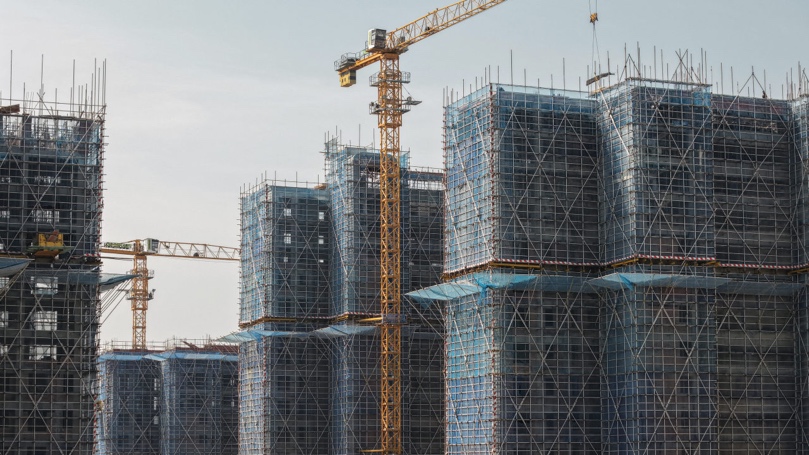
Beijing has unveiled one of its most ambitious infrastructure campaigns in more than a decade, committing at least 15 trillion RMB ($2.2 trillion USD) into overhauling China's cities over the next five years. The plan, released by the State Council as part of Beijing's 15th Five-Year Plan covering 2026 to 2030, signals a decisive shift in how China intends to sustain economic growth as its decades-long property boom fades into history. For Western companies in the construction, infrastructure, and real estate sectors, the plan presents a significant market opportunity and a complex legal and regulatory landscape that requires careful navigation from the outset.
The scale of the investment alone is staggering. State linked media reports suggest the total outlay could climb as high as 20 trillion yuan once the full scope of rebuilding and renovation is factored in. To put that in perspective, that is roughly equivalent to the entire annual GDP of the United Kingdom committed not to building new cities, but to fixing and upgrading the ones that already exist. It reflects the government's continued reliance on infrastructure spending as a primary economic lever.
What the plan actually covers
At its core, this is a plan about fixing what is broken and upgrading what is outdated. Hundreds of thousands of kilometers of underground gas, water, and drainage lines, much of it laid during China's rapid urban expansion decades ago, are due to be replaced or renovated by 2030. Half a million deteriorating urban homes are earmarked for renovation. More than 115,000 old residential communities and around 4,000 urban villages are also included in the targets. Underground pipeline upgrades alone are expected to account for roughly 5 trillion yuan of the total investment envelope.
The State Council's Urban Renewal Guideline, issued under the 15th Five-Year Plan framework, organizes the campaign around six priorities:
- Generating new drivers of urban economic activity
- Improving the quality of living spaces
- Accelerating the shift to greener and lower-carbon cities
- Making urban infrastructure more resilient
- Preserving and promoting urban culture
- Strengthening how cities are governed and managed day to day
What makes this plan different from previous rounds of infrastructure investments is its emphasis on quality over quantity. Rather than building new developments on the urban periphery, the government is directing investment inward into the fabric of existing neighborhoods, the pipes running beneath existing streets, and the homes of existing residents. The ambition, as Beijing frames it, is to fundamentally change the model of urban development from one focused on expanding outward to one focused on improving what already exists.
Why now: the property crisis in the background
To understand why this plan matters, it helps to understand the hole it is trying to fill. China's property sector was once the single most powerful engine of economic growth in the country, accounting for a significant share of GDP, government revenue, and household wealth. At its peak, real estate and related industries contributed close to a quarter of China's total economic output. That engine began seizing up in 2021, when a wave of developer debt crises, most visibly at Evergrande, exposed how dangerously overleveraged the sector had become. Since then, new home sales have fallen sharply year after year. Prices have declined across many cities. Consumer confidence, with roughly 70 percent of household wealth tied to real estate, has taken a lasting hit that monetary policy alone has struggled to reverse.
By 2024, new housing sales nationwide had dropped to 814.5 million square meters, a decline of more than 14% from the previous year. Industry analysts project that annual housing demand will average around 800 million square meters through to 2040, less than half the peak levels seen in 2021. The construction boom that defined the previous two decades, in other words, is structurally over. No amount of policy tinkering is going to bring it back.
The government has tried repeatedly to stabilize the market, cutting mortgage rates, relaxing purchase restrictions, encouraging local authorities to absorb unsold housing inventory. These measures have helped prevent a disorderly collapse, but they have not sparked a recovery. Analysts broadly expect a slow, grinding stabilization rather than a sharp rebound. A V-shaped recovery is no longer a realistic prospect.
Urban renewal represents Beijing's strategic response to this structural shift. Rather than waiting for private developer-led activity to return, the government is redirecting investment toward upgrading existing urban stock as the primary vehicle for sustaining construction sector activity.
Building on existing momentum
It is important to note that this plan is not starting from scratch. China has been quietly laying the groundwork for large-scale urban renewal throughout the previous Five-Year Plan period, and the results have been more substantial than many realize.
In 2024 alone, more than 60,000 urban renewal projects were launched across the country, with total investment reaching 2.9 trillion yuan ($430 billion USD), up from 2.6 trillion yuan ($380 billion USD) the year before, and equivalent to more than a quarter of total real estate investment that year. The numbers speak to a program that was already operating at meaningful scale before the 15th Five-Year Plan commitments were announced.
Going further back, China renovated around 280,000 ageing residential communities between 2019 and 2024, improving living conditions for more than 120 million people in the process. Tens of thousands of elevators were added to older apartment buildings. Hundreds of thousands of parking spaces were created. Thousands of elderly care facilities were built within existing urban neighborhoods. These are not glamorous headline projects, but they represent a genuine and sustained effort to improve daily life in China's cities.
The 15th Five-Year Plan campaign, then, is less a new initiative and more a dramatic scaling-up of something that has been quietly gathering pace for years. Wang Feng, chairman of Shanghai-based financial services group Ye Lang Capital, captured the strategic logic plainly: "Mega reconstruction projects can improve people's welfare and be an important driver for the national economy."
How it will be financed
One of the most closely watched aspects of the plan is how it will actually be paid for. Local governments, which in China bear much of the responsibility for delivering infrastructure investment, will be permitted to issue special-purpose bonds to fund eligible urban renewal projects under the framework established by China's Budget Law. This reflects a broader shift in how Beijing is thinking about the property sector. Rather than relying on land sales, which historically provided local governments with a major source of revenue but created perverse incentives to keep expanding urban boundaries, the new model leans more heavily on bond issuance, budget transfers, and private partnership arrangements. Special-purpose bonds have been a key financing tool in China's infrastructure push in recent years, and extending their application to urban renewal gives local authorities both the mandate and the mechanism to mobilize capital at scale.
Private investment will also be needed if the program is to reach the higher end of its stated ambitions. The government has made clear it wants to attract construction firms, property developers, and institutional investors into the program, positioning urban renewal as a commercial opportunity as much as a policy obligation. For foreign companies, direct participation in government bond issuance is not available. The more accessible route into project financing is through public-private partnership structures, concession agreements, and equity participation in project companies established under Chinese corporate law.
Market reaction: cautious optimism
Financial markets responded positively to the State Council announcement, with mainland listed property stocks rallying sharply in the days that followed. Several developers recorded significant single-day gains, reflecting genuine relief in a sector that has been starved of positive news for the better part of four years.
The reaction was not purely speculative. The inclusion of special-purpose bonds as a financing tool, the specificity of the renovation targets, and the sheer scale of the investment commitment all pointed to a government that is serious about implementation rather than simply issuing aspirational targets. For construction companies, materials suppliers, and engineering firms, the pipeline of work implied by the plan represents a multi-year revenue opportunity of a kind that has been largely absent from the market since the property downturn began.
Yan Yuejin, vice-president at the E-house China Research and Development Institute, reflected the cautiously positive mood in the sector: "The sector has weathered its most severe adjustment, with overall market sentiment turning noticeably positive."
The challenges ahead
Optimism about the plan needs to be tempered with a realistic assessment of the obstacles standing between announcement and delivery. Local government finances still remain a significant concern. Many municipal authorities across China are carrying heavy debt loads accumulated during years of land-sale-dependent spending, and their capacity to co-invest meaningfully in urban renewal varies enormously from one region to the next. Richer coastal cities with strong economic bases may be well positioned to move quickly and attract private partners. Poorer inland municipalities, where the need for urban upgrading is often greatest, may find themselves constrained by limited fiscal headroom.
Execution at scale is also a genuine challenge that is easy to underestimate. Coordinating hundreds of thousands of simultaneous renovation projects across hundreds of cities while minimizing disruption to existing residents, maintaining construction quality, and managing contractor relationships is administratively complex in ways that a headline investment figure does not begin to capture. China's track record on large infrastructure programs is generally strong, but urban renewal in densely populated existing neighborhoods is a different operational challenge from building new roads or railways on greenfield sites.
The plan's ability to restore broader consumer confidence in the property market is also limited. Physical upgrades to housing and infrastructure address supply-side conditions, but household sentiment is shaped by wider economic factors including employment stability, income growth, and expectations around property values. These are not directly within the plan's reach.
Key legal considerations for foreign companies
For Western companies looking to participate in China's urban renewal program, the opportunity is tangible but the path to participation requires careful legal structuring from the outset.
Under China's Foreign Investment Law, which came into effect in 2020, foreign companies may participate in China's construction and real estate sectors subject to restrictions set out in the national Negative List. The appropriate corporate structure, whether a wholly foreign owned enterprise, a Sino foreign joint venture, or an acquisition of an existing Chinese entity, will depend on the specific activity, sector classification, and the foreign company's strategic objectives. Each structure carries different implications for control, liability, profit repatriation, and regulatory compliance.
A fundamental point for any foreign company entering China's property or construction market is that China does not recognize freehold land ownership. Under the Urban Real Estate Administration Law, all land is state-owned and companies operate based on land use rights granted for fixed terms. Urban renewal projects frequently involve the transfer, renegotiation, or early termination of existing land use rights, and understanding the legal status of the land underlying a project is an essential part of due diligence.
Under China's Construction Law, all construction activities must be carried out by entities holding the appropriate qualification certificates issued by the relevant authorities. Foreign companies typically cannot hold these licenses directly and will need to engage or partner with appropriately licensed Chinese contractors. The structure of those arrangements, and the allocation of risk within them, requires careful attention in contract drafting.
Contract structuring and dispute resolution. Construction contracts in China are governed by the Civil Code and sector-specific regulations. Standard international contract forms are not automatically enforceable in their original format and will generally need to be adapted to Chinese legal requirements. Where disputes arise, foreign companies should consider whether arbitration, including through recognized institutions such as CIETAC or under Hong Kong-seated arbitration, is preferable to litigation in Chinese courts, and ensure that dispute resolution clauses are properly drafted to reflect that preference.
Conclusion
China's US$2.2 trillion urban renewal campaign marks more than a construction spending spree. It represents a fundamental shift of how the world's second-largest economy plans to grow from here. With the era of breakneck urbanization behind it, Beijing is betting that upgrading what already exists can generate the economic momentum that building new cities once provided. The scale of ambition is real, but so are the obstacles: stretched local government finances, execution complexity at an unprecedented scale, and a consumer confidence problem that bricks and mortar alone cannot fix. For businesses and investors operating in or looking to enter China's construction, property, and infrastructure sectors, this plan creates both significant opportunity and equally significant legal and regulatory complexity, from navigating special-purpose bond frameworks and public-private partnership structures to managing contractor risk, land use rights, and cross-border investment compliance. Taking early legal advice on how this policy shift affects your specific exposure is not just prudent, it is essential.
References
Cortesi, J. S. (2026, January 13). China housing market downturn and its impact. GAM Investments. gam.com
Hairong, Y. (2026, May 29). China unveils sweeping five-year urban renewal plan. Caixin Global. caixinglobal.com
Ren, D. (2026, May 29). China's US$2.2 trillion urban renewal plan to boost construction, property sectors. South China Morning Post. scmp.com
Wenqian, Z. (2026, June 1). China's property market shows more positive signs with price, sales upticks. South China Morning Post. scmp.com
Xinhua. (2024, December 25). China to advance urban renewal projects in 2025. The State Council of the People's Republic of China.
Xinhua. (2025, May 15). China doubles down on urban upgrades to boost high-quality development. The State Council of the People's Republic of China. english.www.gov.cn