
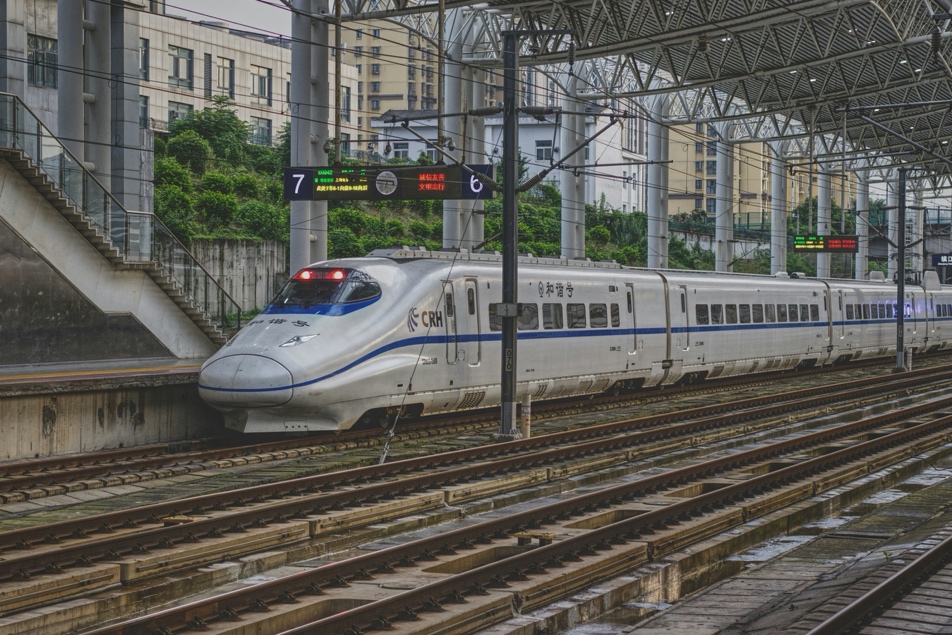
Eight Chinese government departments published a 15-point notice last week announcing plans to develop more than 160 dedicated tourist train units by 2030. The joint document, released by the Ministry of Commerce, the Ministry of Culture and Tourism, and China State Railway Group, among others, frames the initiative as a strategy to integrate rail infrastructure with tourism and expand what officials describe as "service consumption."
The policy lands in a specific economic moment. Household consumption accounts for just under 40% of China's GDP, well below the 60 to 70% typical of developed economies. The gap has historically been covered by property investment, government infrastructure spending, and exports. All three are under pressure. Retail sales grew 3.7% in 2025, lagging industrial output growth of 5.9%. Consumer prices were flat for the year, and producer prices declined for a third consecutive year. In that context, the tourist train announcement is less a rail policy than a demand stimulus experiment dressed in tourism language.
What the Policy Actually Says
The 15-measure document calls for accelerating tourism-oriented infrastructure upgrades, improving elderly-friendly facilities, creating dedicated tourist waiting areas at stations, and establishing convenient transfer channels. Social capital will be encouraged to invest in the renovation of tourist trains. Officials have also indicated that tourist trains will be encouraged to collaborate with branded intellectual property to develop themed carriages.
The rail baseline is not modest. In 2025, 2,485 tourist trains operated across the national railway network, up 33.6% year-on-year. China's railway network recorded 4.255 billion passenger trips over the same period, with tourism-related travel accounting for roughly one-third of the total and representing the fastest-growing category of rail passenger transport.
The Chongqing experience offers one benchmark. The city's Bashu corridor saw 616 tourist trains generate 3.2 million trips and over 3 billion yuan in spending in 2025. That is the kind of downstream consumption multiplier Beijing is trying to replicate at national scale.
The Inbound Tourism Layer
The tourist train policy does not exist in isolation. It sits within a wider effort to attract foreign visitors and capture their spending. China's high-speed rail network has become a distinct attraction for some foreign travelers as international tourist arrivals rise, supported by expanded visa-free entry policies and growing cultural influence.
The visa-free numbers support that framing. Data released in January 2026 by the Ministry of Public Security showed that 292,000 foreigners entered China via visa-free or transit schemes over the New Year holiday, up 35.8% year-on-year. Trip.com reported a 100% increase in air and hotel bookings in the first quarter, with companies like WildChina seeing 50% business growth compared to pre-pandemic levels.
China now extends 30-day visa-free access to citizens of Canada, the United Kingdom, Sweden, Russia, and dozens of other countries, with most arrangements running through the end of 2026. The tourist train expansion is designed partly to give those arriving visitors a reason to travel deeper into the country, beyond the tier-one cities where inbound tourism has traditionally concentrated.
The Structural Problem Behind the Policy
The honest read on this initiative is that China's consumption challenge runs deeper than transport supply. Household deposits increased by 15 and 18 trillion RMB in 2023 and 2024, equivalent to roughly 11 to 13% of GDP each year. In the first half of 2025, another 10 trillion RMB was added. Chinese households are not spending because they lack trains. They are not spending because of impaired confidence, property sector losses, and labor market uncertainty.
A macro strategist at Wellington Management observed that the share of consumption in GDP could grow in 2026 "if we see effective policies to stabilize the property sector and household incomes," adding that policies focused on lifting long-term income growth matter more than one-off windfalls.
Tourist trains are not a one-off windfall exactly, but neither are they the structural reform economists keep calling for. They are a supply-side intervention in a demand-side problem. The government can build themed carriages and bamboo scenery routes. It cannot force a household sitting on three years of precautionary savings to spend those savings on a sleeper train to Guizhou.
That said, service consumption does appear to be shifting at the margin. A People's Bank of China survey for the fourth quarter of 2025 showed an eight-year peak in consumer plans to increase spending on social and entertainment activities. The preference is moving from goods to experiences. Tourist trains, if well-executed and priced accessibly, fall squarely in the experience category. The question is scale and substitution: whether this generates net new consumption or simply redistributes existing leisure spending onto a different mode of transport.
What This Means for Businesses and Investors
For cross-border investors and operators, the practical takeaways from this policy are more specific than the headline suggests.
The tourism supply chain stands to gain. Hotels, food and beverage operators, cultural attraction operators, and logistics providers along tourist rail corridors will see increased footfall if the program reaches its targets. The Chongqing data suggests the downstream spending effect is real, not theoretical.
Foreign operators should pay attention to the market access signals embedded in the policy. The 15-point document confirms plans to expand the list of countries eligible for unilateral visa-free entry and to optimize transit visa-free arrangements, with authorities also studying the introduction of electronic visas and pilot online visa applications. That is a progressive liberalization of entry conditions, not a static policy position.
The encouragement of social capital participation in tourist train renovation is also worth noting. This is an explicit opening for private and potentially foreign investment in what has traditionally been state-dominated rail infrastructure. The boundaries of that opening are still undefined and will require careful review as implementing regulations emerge.
For law firms and advisory practices, the policy creates transactional opportunities in the hospitality and tourism sectors, franchise and IP licensing for themed train collaborations, and infrastructure investment structuring as private capital is encouraged in. The cross-border dimension expands as inbound tourism grows and foreign operators seek market entry.
The Broader Signal
Beijing's willingness to deploy eight government departments on a tourist train initiative tells you something about where domestic demand policy is heading under the 15th Five-Year Plan framework. China's 2026-2030 plan is more explicit than previous plans about raising the consumption share of GDP, with analysts describing the pledges as going beyond the longstanding but vague goal of expanding domestic demand.
Whether tourist trains contribute to that structural shift or simply generate favorable headlines depends largely on factors the policy cannot control: household confidence, income expectations, and the pace of property sector stabilization. The rail corridors will exist regardless. Whether people choose to ride them for leisure, rather than squirreling away another month's salary, is the question the 15-point notice does not answer.
References
China Daily. (2026, June 11). China charts course for railway tourism growth. chinadaily.com.cn
CKGSB Knowledge. (2026, February 26). How China boosts consumption as growth slows. english.ckgsb.edu.cn
East Asia Forum. (2025, August 10). China's consumption weighed down by weak expectations. eastasiaforum.org
Reuters. (2026). Analysis: China signals sharper pivot to consumption as imbalances worsen. aol.com
South China Morning Post. (2026, June 11). Panda and pet services: China plans over 160 tourist trains to boost consumption. scmp.com
VisaHQ News. (2026, January 20). China's inbound tourism roars back as visa-free arrivals jump 35.8%. visahq.com
WebProNews. (2026, January 30). China's services spending surge: Trains, cruises and concerts to ignite demand. webpronews.com
Wellington Management / China Daily. (2025, December 25). Chinese economy rides the crest of new consumer phenomena. chinadaily.com.cn